How to Use Y-DNA Testing to Trace Your Ancestry

Have you ever wondered where your McNeill or Macneil line really came from—or how you're related to others with your surname around the world? Y-DNA testing gives you a way to find out, and no, you don’t need to be a scientist to understand it.

🧬 What Is Y-DNA (and Why Should You Care)?

Y-DNA is a special kind of DNA that only males have. It's passed directly from father to son, almost unchanged, for thousands of years. That means it can tell you a lot about your father’s father’s father’s father, all the way back—potentially even to medieval Scotland or beyond.

If you carry the Macneil/McNeill name or are descended from a male Macneil line, this is the one test that gives you the clearest picture of your ancient and more recent paternal ancestry.


🔍 What Can Y-DNA Tell You About Your Macneil Line?

  • Find out which Macneil/McNeill family line you come from – There are multiple groups: Barra, Gigha, Colonsay, Ulster, etc. Y-DNA helps you figure out which one you belong to.
  • See how you're related to others with the same surname – Are you a close cousin or just share the name?
  • Connect with distant cousins worldwide – From Scotland to Canada to Australia.
  • Discover where your paternal ancestors lived hundreds or even thousands of years ago – Based on your haplogroup (your genetic “branch” on the tree of mankind).

🧪 Which Test Do You Need?

There are two main Y-DNA tests available from FamilyTreeDNA:

Y-37 (Entry Level)
  • Tests 37 markers.
  • Great for getting started, especially if budget is tight.
  • Can be upgraded later.
🔥 Big Y-700 (Best Value)
  • Tests 700+ STRs and over 500,000 SNPs.
  • Places you precisely on the Y-DNA tree.
  • Shows detailed matches, rare mutations, and deeper ancestry.
  • Recommended for anyone who wants serious answers.

If you can afford Big Y-700, start there. Otherwise, begin with Y-37, see who you match, then upgrade.


🌲 What’s a Haplogroup, and Why Does It Matter?

Think of a haplogroup like your family's “chapter” in the big book of humanity. Every male line belongs to a different branch of the Y-DNA family tree. For example:

  • Macneils of Barra tend to show one haplogroup (such as R1b).
  • McNeills of Ulster or Lowland Scotland may show another.
  • Ancient differences can point to Norse, Celtic, or even Iberian roots.

Once you test, you'll see exactly where your branch fits—and how it compares to others in the MacNeil Y-DNA Project.


🧭 How to Use the Results (Even If You’re Not a DNA Geek)

  • Compare yourself to known testers from your surname group.
  • Check the maps – Where are your closest matches located?
  • Read the tree – Your place in the Y-DNA haplotree shows how far back you share a common ancestor with others.
  • Watch for new discoveries – As more men test, new branches form and your results get updated automatically.

👨‍👩‍👧 Can Women Use Y-DNA?

Not directly—but you can ask a male relative to test:

  • Your brother, uncle, cousin, or father—as long as they carry the Macneil Y line.
  • Make sure they descend from the right male line you’re researching.

⚠️ Important Tip

Not all Macneils are genetically related. Some took the name through adoption, clan loyalty, or local tradition. Y-DNA testing helps cut through that confusion and prove whether the connection is real or just on paper.


🎯 Final Thought: Why This Matters

Y-DNA isn't just about ancient history—it’s about knowing where your people come from. It’s about reconnecting with your roots, discovering cousins across the globe, and strengthening our collective Macneil story.

So if you're a Macneil, McNeill, or one of our related families—test your Y-DNA. You're not just doing it for yourself. You're doing it for the clan.

How to Use Y-DNA Testing to Trace Your Ancestry Read More »
The-Scottish-and-Irish-Migration-Connection-wid

The Scottish and Irish Migration Connection: How Clan Families Settled in New Lands

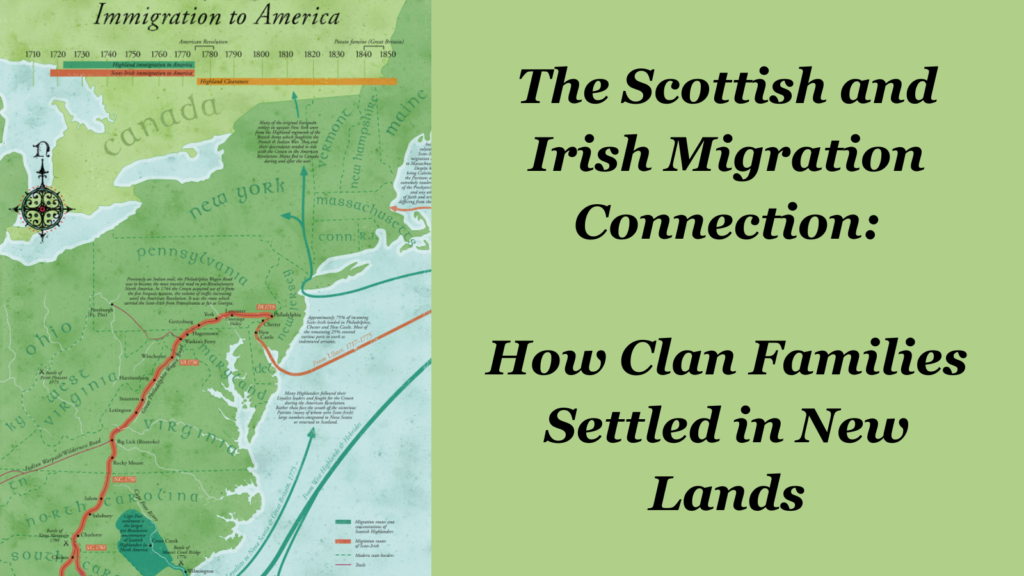
Migration has long been a defining aspect of Scottish and Irish history, and the clan families were no exception. Across centuries, waves of migration carried these families from their homelands to new regions, shaping the cultural identities of communities worldwide. Influenced by war, famine, British policies, and economic opportunities, these movements contributed to the spread of Scottish and Irish heritage across North America, Australia, and beyond.

Timeline of Migration

  1. Early Scottish and Irish Movement (Pre-1600s)
    • Before major conflicts and colonization, Scottish and Irish clans primarily migrated within the British Isles.
    • Many sought new lands within Scotland and Ireland due to clan disputes or shifting allegiances.
  2. Plantation of Ulster (1609–1690s)
    • Scottish Presbyterians were encouraged by the British Crown to settle in Northern Ireland, displacing native Irish populations.
    • Some McNeill families in Northern Ireland trace their lineage to this period, settling primarily in Antrim and Down.
  3. Jacobite Uprisings and Forced Migration (1715–1746)
    • The defeat of Scottish Highlanders in the Jacobite Rebellions led to mass displacement.
    • Many Highland Scots, including Macneils of Barra and McNeills of Gigha, were forced to flee to North America to escape persecution.
  4. Irish Famine and Economic Migration (1840s–1870s)
    • The Great Famine (1845–1852) devastated Ireland, prompting mass emigration to the United States, Canada, and Australia.
    • Irish McNeills and Ulster Scots took advantage of immigration programs and opportunities in cities and rural settlements.
  5. 20th Century Migration and the Scottish Diaspora
    • Economic hardship in Scotland and Ireland continued to push people abroad.
    • Scots-Irish communities became deeply rooted in American culture, particularly in Appalachia and the Southern United States.

How Conflicts and Policies Shaped Migration

  • The Highland Clearances (1750s–1860s): Landowners forcibly removed tenant farmers to make way for sheep farming, driving thousands of Scottish families to Canada, the U.S., and Australia. Many Macneils of Barra emigrated during this time.
  • Penal Laws and Religious Persecution: Catholic and Presbyterian Scots faced discrimination under British rule, prompting voluntary and forced migration.
  • The American Revolution (1775–1783) & Civil War (1861–1865): Scots-Irish immigrants played key roles in these conflicts, shaping their status in North America.
  • The Industrial Revolution (1800s–1900s): Economic shifts led to job opportunities in cities, attracting Scottish and Irish immigrants to manufacturing hubs.

Regional Identities and Genetic Connections

  • Appalachian Scots-Irish Influence: Many Scots-Irish settlers, including McNeills, became part of the Appalachian frontier, bringing their customs, music, and storytelling traditions.
  • Maritime Canada’s Scottish Settlers: Nova Scotia (“New Scotland”) saw a major influx of Macneils, particularly from Barra, preserving strong Gaelic traditions.
  • The Gigha McNeills and Highland Identity: The McNeills of Gigha are often categorized as Highlanders due to their Gaelic heritage and clan structure, but their coastal location near Kintyre also placed them in contact with Lowland influences. They were part of the Gaelic maritime culture that spanned from the western Highlands to Ulster. Their genetic history shows both Highland and Norse ancestry, reflecting centuries of interaction in the region.
  • DNA and Family Links: Genetic studies reveal strong connections between McNeill/Macneil lineages and broader Celtic ancestry, showing how migration patterns shaped genetic diversity.

Conclusion

The migration of clan families was shaped by a complex web of conflict, policy, and opportunity. From forced displacement to voluntary settlement, these movements left a lasting imprint on regions around the world. Understanding these migrations helps preserve the history of these families and their enduring cultural legacies.

The Scottish and Irish Migration Connection: How Clan Families Settled in New Lands Read More »

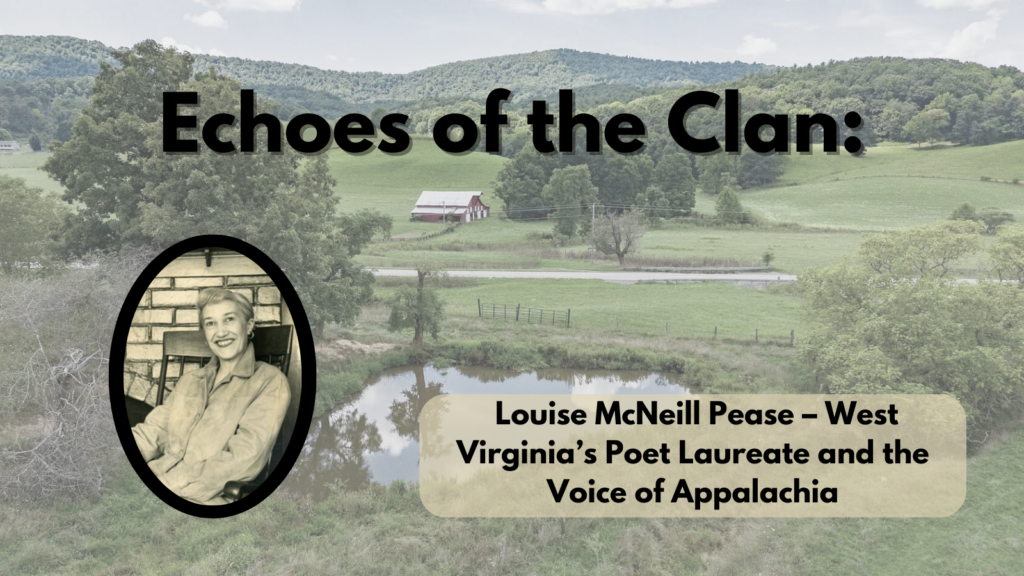
Echoes of the Clan: Louise McNeill Pease – West Virginia’s Poet Laureate and the Voice of Appalachia

Louise McNeill Pease (1911–1993) was a distinguished Appalachian poet, historian, and educator from West Virginia. Born on January 9, 1911, in Buckeye, Pocahontas County, she grew up on a family farm established in 1769. Her father, G.D. McNeill, was also a writer, authoring The Last Forest, which chronicled the decline of wilderness in Pocahontas County. Influenced by her father’s love of storytelling and history, McNeill developed an early passion for poetry and began writing at the age of 16.

A Pioneering Literary Figure in Appalachia

McNeill was a trailblazer in Appalachian literature, bringing the voices of her people to the forefront. She infused her work with the dialects, rhythms, and landscapes of West Virginia, making her poetry an authentic reflection of life in the region. Her collections, such as Mountain White (1931), Gauley Mountain (1939), and Paradox Hill (1972), weave a narrative of tradition and change, chronicling the Appalachian experience with precision and deep emotion.

Her most renowned work, Gauley Mountain, is a poetic history of West Virginia that intertwines personal memories with larger historical themes. It remains a defining text in Appalachian studies, celebrated for its lyrical storytelling and historical depth. Her memoir, The Milkweed Ladies (1988), provides a deeply personal and vivid portrayal of Appalachian farm life, capturing the intersection of personal experience and broader historical shifts.

A Historian of West Virginia’s Cultural and Environmental Shifts

McNeill was not just a poet; she was a historian who documented the profound transformations of West Virginia. She pursued higher education at Concord College (now Concord University), earning a bachelor's degree in English in 1936. She furthered her studies with a master’s degree from Miami University in Ohio in 1938. In 1939, she married Roger Pease and continued her academic journey, eventually earning a doctorate in history from West Virginia University in 1959.

Her teaching career spanned over three decades, during which she taught English and history at various institutions, including rural one-room schools in West Virginia, Potomac State College, Fairmont State College, and West Virginia University. McNeill’s writing serves as a historical record, capturing the displacement of communities, the environmental consequences of coal mining, and the loss of traditional ways of life. Through her work, she preserved the stories of those who might have otherwise been forgotten, ensuring that the struggles and triumphs of Appalachia remained in the public consciousness.

A Poet Who Captured the Spirit of the People and the Land

McNeill’s poetry is deeply rooted in the land and people of Appalachia. She wrote of coal miners, farmers, mothers, and laborers, elevating their stories through her art. Her work is rich with themes of nature, family, and survival—expressing both the harsh realities and the enduring strength of Appalachian culture.

Unlike many literary figures of her time, McNeill did not romanticize rural life. Instead, she presented it as it was—filled with both breathtaking beauty and relentless struggle. Her ability to balance these truths made her one of the most authentic voices in Appalachian literature.

A Trailblazer in a Male-Dominated Literary World

As a woman in the early-to-mid 20th century, McNeill carved out a space for herself in a literary world dominated by men. She was a scholar, educator, and poet who defied expectations and left an enduring mark on the literary landscape.

In 1979, Governor Jay Rockefeller appointed her as West Virginia’s poet laureate, a position she held until her death in 1993. Her appointment was a groundbreaking achievement, solidifying her influence in both literary and academic circles. She used this platform to champion Appalachian literature and advocate for the recognition of voices from the region.

Throughout her career, McNeill received numerous accolades, including the Appalachian Gold Medallion in 1988 and honorary degrees from Fairmont State College and West Virginia University. Her contributions to literature and education have left an indelible mark on Appalachian cultural heritage.

The Legacy of Louise McNeill Pease

Louise McNeill Pease remains a towering figure in Appalachian literature, her legacy woven into the very fabric of West Virginia’s cultural history. Her poetry and prose continue to be studied, celebrated, and admired for their depth, authenticity, and historical significance.

Through her words, she gave voice to the people of Appalachia, preserved the history of a rapidly changing region, and broke barriers as a woman in literature. Her influence endures, reminding us that poetry is not just an art form—it is a means of recording, reflecting, and reshaping the world around us.

Echoes of the Clan: Louise McNeill Pease – West Virginia’s Poet Laureate and the Voice of Appalachia Read More »

The Septs of Clan Macneil: Exploring the Extended Family

Introduction

While the names Macneil or McNeill are the most commonly associated surnames with Clan Macneil, the clan’s extended family includes several historically recognized septs—families that, while bearing different surnames, are part of the broader kinship network. These septs have connections to the clan through blood, allegiance, or historical association. Understanding these septs can help members with different surnames trace their own lineage and find their place within Clan Macneil’s history.

What Is a Sept?

A sept is a branch of a Scottish clan that historically aligned with or descended from the dominant clan. While sept names may differ from the main clan name, they were often smaller family groups that found protection under a powerful clan or shared a common ancestor. Septs were a way for larger clans to grow in influence while maintaining kinship bonds.

Recognized Septs of Clan Macneil

Research and historical records have identified several surnames that are recognized as septs of Clan Macneil. These include:

  • MacGougan / MacGugan
  • MacGrail / MacGuigan
  • MacneilageMacNeilageMacneilageMacNeelageMacneileMacNeileMacNiellMacnielageMacNielageMacniellMacNiellageMacNielle
  • NealeNealNeallNealle, Neill
  • MacNeilMcNeilMacneilMcneil
  • MacNeillMcNeillMacneillMcneill
  • MacNialMacNiallMcNialMcNiall
  • McNeelyMcNeeleyMcneelyMcneeley
  • NelsonNeilsenNeilson
  • O’NeailO’NealO’Neil, O'Neill

Each of these names has a historical connection to Clan Macneil, either through ancestry, shared Gaelic roots, or historical allegiance to the clan.

Origins and Connections of the Septs

Each of these septs has its own unique history while remaining connected to the larger Macneil kinship network:

  • MacNeilMcNeilMacneilMcneil
    • Origin: These are the most direct forms of the surname, derived from the Gaelic "Mac Néill," meaning "son of Neil." Neil is a Gaelic name meaning "cloud" or "passionate" and is associated with Saint Niall of the Nine Hostages, a legendary Irish king.
  • MacNeillMcNeillMacneillMcneill
    • Origin: Similar to the MacNeil group, these variations also come from "Mac Néill," with the addition of a double "l" which is common in many Scottish surnames.
  • NealeNealNeallNealle, Neill
    • Origin: These names are anglicized forms of the Gaelic "Ó Néill," meaning "descendant of Neil," but are more commonly associated with Clan O'Neill in Ireland. However, they can also appear in Scotland as variations or simplifications of the MacNeil name.
  • MacNialMacNiallMcNialMcNiall
    • Origin: These variations reflect the Gaelic "Mac Néill" with a focus on the "Niall" form, which is closely tied to the legendary Irish king Niall of the Nine Hostages.
  • MacneilageMacNeilageMacneilageMacNeelageMacneileMacNeileMacNiellMacnielageMacNielageMacniellMacNiellageMacNielle
    • Origin: These are more complex variations that likely arose from different pronunciations or spellings of the name over time. They often include additional suffixes or modifications that were common in Scottish naming traditions.
  • McNeelyMcNeeleyMcneelyMcneeley
    • Origin: These names are likely derived from the diminutive form of "Neil," indicating "little Neil" or "son of little Neil."
  • NelsonNeilsenNeilson
    • Origin: These names are patronymic surnames derived from "son of Neil," but they are more commonly associated with English or Scandinavian naming traditions rather than directly with Clan MacNeil.
  • O’NeailO’NealO’Neil, O'Neill
    • Origin: These names are typically associated with the Irish Clan O'Neill, but they can appear in Scottish contexts as well, especially in historical documents where the distinction between Scottish and Irish clans was less clear-cut.
  • McGrail
    • Origin: The McGrail surname is derived from the Gaelic "Mag Reill," which is akin to the Mac Neill sept in Ireland. However, in Scotland, McGrails were found on the islands of Barra, Gigha, Colonsay, and Oronsay.
    • Association: While McGrail is not a direct derivation of MacNeil, it is associated with Clan MacNeill through geographic proximity and possibly historical alliances.
  • McGugan
    • Origin: The McGugan name is derived from the Gaelic "Mac Eochagáin" or "Mac Eoganán," meaning "son of Eoganán," a diminutive of Eogan. It is primarily associated with the Knapdale, Gigha, and Kintyre areas of Argyll, Scotland.
    • Association: McGugan is recognized as a sept of Clan MacNeil, particularly associated with the McNeils of Gigha and Taynish, though the exact connection is unknown. It is also linked to Clan Donald.
  • Mcguigan
    • Origin: In Ireland, McGuigan is derived from the Gaelic "Mag Uiginn," associated with County Tyrone and the Cineal Eoghain, tracing back to Niall of the Nine Hostages. In Scotland, McGuigans are recognized as a sept of Clan MacNeill.
    • Association: While McGuigan is not directly derived from MacNeil, it is associated with Clan MacNeill in Scotland. In Ireland, McGuigans are closely tied to the O'Neills, who also descend from Niall of the Nine Hostages

How to Determine If Your Surname Connects to Clan Macneil

If you carry one of these surnames, you may have a historical or genealogical connection to Clan Macneil. Here’s how you can explore your lineage further:

  1. Check Family Records – Look for any historical mentions of Macneil associations within your own family history.
  2. Use Y-DNA Testing – Participate in the Clan Macneil Y-DNA Surname Project to see if your lineage aligns with the known Macneil genetic markers.
    • https://www.familytreedna.com/groups/mac-neil/about
  3. Explore Scottish and Irish Archives – Search parish records, land documents, and census data for connections to traditional Clan Macneil territories.
  4. Engage with Clan Macneil Organizations – Clan societies and genealogical groups often provide resources for those researching their family’s connection to the Macneils.
    • https://clanmacneilusa.us/

Conclusion

The history of Clan Macneil extends beyond the Macneil/McNeill surname to include a variety of septs that have played an integral role in the clan’s legacy. Whether you bear the name MacGugan, Neale, or another recognized sept surname, your family may have historical ties to Clan Macneil. Researching your ancestry through historical records and DNA projects can provide deeper insight into your place in the wider Macneil family tree.

The Septs of Clan Macneil: Exploring the Extended Family Read More »

Scottish and Irish Genealogical Connections: Tracing Your Ancestry Across the Isles

Introduction

The shared history between Scotland and Ireland is deeply intertwined, with centuries of migration, cultural exchange, and family connections. For genealogists researching their Scottish and Irish heritage, understanding the historical movements of people between these two regions is essential. This blog post explores the geographic, historical, and genealogical ties that connect Scotland and Ireland, offering insights into key events and resources that can aid in tracing your family’s past.

Understanding the Geographic and Historical Links

Scotland and Ireland are separated by just 12 miles (19 km) at their closest point. The movement of people between these lands has been constant for centuries, particularly between the north of Ireland and the southwest of Scotland. Trade, marriage, and shared cultural traditions have linked the regions in ways that are still visible today.

The Plantation of Ulster

One of the most significant events influencing Scottish-Irish genealogy was the Plantation of Ulster in the early 1600s. Scottish settlers, mainly from lowland Scotland, were encouraged to settle in Ulster (modern-day Northern Ireland) by the English Crown. These settlers brought their surnames, customs, and Presbyterian faith with them, leaving a lasting impact on Irish society.

For those researching their genealogy, the Plantation of Ulster means that many Scots-Irish families today can trace their lineage back to both Scotland and Ireland. Resources such as land records, muster rolls, and parish registers can provide valuable clues.

The Irish Famine and Migration to Scotland

Between 1845 and 1855, Ireland experienced the Great Famine, leading to the mass displacement of millions of people. While many emigrated to the United States, Canada, and Australia, a significant number moved to Scotland, particularly to cities like Glasgow and Liverpool. By 1847, an estimated 50,000 Irish migrants had arrived in Glasgow alone.

Scottish census records from the 19th and early 20th centuries often list Irish-born residents. However, before 1911, Scottish census takers were only required to record an individual’s country of birth, not their specific county or parish of origin. Despite this limitation, some census takers went beyond the requirements and included town or county details, making them valuable resources for genealogy research.

Genealogical Challenges and Strategies

Researching Scottish-Irish ancestry presents unique challenges, but the right strategies can help overcome these obstacles:

  • Use Surname Heatmaps – Tools like surname heatmaps can help identify the historical distribution of family names in Scotland and Ireland, giving clues about ancestral origins.
  • Explore Poor Law Records – Many Irish immigrants in Scotland applied for poor relief, and these records often contain detailed family information, including places of origin in Ireland.
  • DNA Testing and Ancestral Regions – DNA tests can help confirm connections between Scottish and Irish family lines, especially when combined with historical research.
  • Leverage Local Archives – Scottish and Irish archives house valuable records, including parish registers, land deeds, and migration documents.

Key Resources for Research

  1. Scottish and Irish Census Records – Available through the National Records of Scotland and the National Archives of Ireland.
    • https://www.nrscotland.gov.uk/
    • https://nationalarchives.ie/
  2. Poor Law Relief Records – Held in local Scottish archives and often provide detailed family histories.
  3. Land and Tax Records – The Plantation of Ulster and subsequent land transactions left a wealth of documents.
    • https://ulster-settlers.clericus.ie/
    • https://ulsterhistoricalfoundation.com/ulster-plantation/sources
  4. Church Records – Catholic and Presbyterian records in both countries can provide vital baptismal, marriage, and burial information.

Conclusion

The deep historical ties between Scotland and Ireland mean that many family trees span both nations. By using historical context, archival research, and modern genealogy tools, you can uncover connections that link your family across the Irish Sea. Whether your ancestors were part of the Ulster Plantation, migrated during the Irish Famine, or settled in Scotland for work, their stories are waiting to be discovered in the rich records of both countries.

Scottish and Irish Genealogical Connections: Tracing Your Ancestry Across the Isles Read More »

Tracing Your Macneil/McNeill Ancestry: Navigating the Name Variations

Introduction

If you’ve ever researched your Macneil or McNeill ancestry, you’ve likely encountered multiple spellings of the surname. Some records list Macneil, others McNeill, and occasionally, variations such as MacNeill or McNeal appear. Do these differences indicate distinct family lines, or are they simply historical inconsistencies? Understanding the origins of these variations can help you uncover your true lineage and connect with the greater Clan Macneil family.

The Origins of the Macneil/McNeill Name

The variations in spelling stem from Scotland’s historical transition from Gaelic to Scots and later to English. In Gaelic, the name is traditionally rendered as "Mac Néill," meaning "son of Niall." However, as the name passed through different dialects and written records, spellings shifted.

  • Macneil: Most commonly associated with the Macneils of Barra, this spelling reflects the clan’s origins in the Outer Hebrides.
  • McNeill: More often linked to the McNeills of Gigha and Colonsay, this version became standardized in Argyll and mainland Scotland.
  • Other Variants: Names like MacNeill, MacNeal, and McNeal emerged in Scottish and Irish records, influenced by regional accents and phonetic spellings.

Despite these differences, all these names share a common Gaelic root, meaning they likely stem from the same or closely related ancestral lines.

Macneil of Barra vs. McNeill of Gigha & Colonsay

Two primary branches of Clan Macneil exist, each with its own distinct historical path:

  • The Macneils of Barra: Centered on Kisimul Castle, this line is recognized as the senior branch of Clan Macneil. Their history is filled with seafaring legends, including claims of piracy and loyalty to the Lords of the Isles.
  • The McNeills of Gigha and Colonsay: A separate branch that controlled lands in Argyll, these McNeills played an administrative role in the Lordship of the Isles and had connections to mainland Scotland.

Understanding which branch your family comes from can help refine your genealogical search.

Understanding Records & DNA Testing

To trace your ancestry effectively, it’s crucial to use historical records and modern DNA tools.

Key Historical Records:

  • Scottish Parish Registers (baptisms, marriages, burials) – Available through ScotlandsPeople.
  • Census Records (1841 onward) – Provide household data to track family movements.
  • Land & Tax Records – Identify family holdings and location-based connections.
  • Clan Macneil Y-DNA Project – A genetic study that helps confirm descent from specific Macneil/McNeill branches.

How to Determine Your Ancestral Lineage

  1. Start with Family Records – Speak to relatives and gather any available birth, marriage, or death certificates.
  2. Use Online Archives – ScotlandsPeople, FamilySearch, and Ancestry.com offer extensive Scottish records.
  3. Join the Clan Macneil Y-DNA Surname Project – If available, a Y-DNA test can help determine your connection to the Barra or Gigha branches.
  4. Connect with Clan Associations – Organizations like Clan Macneil USA can provide guidance and historical insights.

Conclusion

While Macneil and McNeill share a linguistic origin, genetic and historical records suggest they have developed into distinct lineages over time. By understanding the historical context, using the right records, and considering DNA testing, you can uncover your own place in Clan Macneil’s rich heritage. Whether your ancestors hailed from Barra’s seafaring stronghold or the administrative lands of Argyll, your connection to this proud Scottish lineage remains strong.

Tracing Your Macneil/McNeill Ancestry: Navigating the Name Variations Read More »

The Clan Niall Chronicles: The Living Presidents of Clan Macneil USA

Welcome to the inaugural episode of The Clan Niall Chronicles. Clan Macneil USA celebrates 100 years of our proud Scottish & Irish heritage and diverse roots through friendly association, the promotion of traditions and culture, and the sharing of information.

Our host, Alissa Nolan, kicks off the celebrations as The Clan Niall Chronicles interviews 3 of its living presidents: Kenny McNeil, Robert Neill, and Neill Baker. We are so fortunate to listen to their memories, discuss issues that relate to any membership-driven organization, and hear what the future holds for Clan Macneil USA. It's a treasure-trove of history for future generations!

All of our podcasts are available via our podcast page on our website - check it out here: https://clanmacneilusa.us/podcast/

Want to help?

While Alissa Nolan, Council Member and Clan Genealogist, will initially get this project off the ground, she will need help. She's is seeking a volunteer experienced in podcast hosting who can take over. Alissa is also seeking a volunteer production assistant (PA) who can help put together the themes for each show, develop questions and concepts, and help schedule the guests.

Contact us!

Are you a possible guest? Got an intriguing ideas for an episodes of The Clan Niall Chronicles? Reach out to us and share! If volunteering as a host or PA is your thing, let us know! For either, contact Alissa at podcast@clanmacneilusa.us. We can't wait to hear from you!

***Please note that guests must have a video camera and microphone as all interviews will be conducted on Zoom.

The Clan Niall Chronicles: The Living Presidents of Clan Macneil USA Read More »

Coming soon – The Clan Niall Chronicles!

Coming soon to Clan Macneil USA's YouTube channel is our brand-new podcast - The Clan Niall Chronicles!

Our podcast

Welcome to The Clan Niall Chronicles, our exciting monthly podcast that takes you on a captivating journey through our collective history and the vibrant stories of our members. Prepare yourself to dive into the tales from the presidents of our organization, The Galley editors and contributors, commissioners, MOM winners, and remarkable individuals representing the diverse septs across the globe.

Join us as we explore a wide range of fascinating topics, including riveting historical accounts, cherished traditions, and the intriguing world of genealogy & DNA. Each episode is a treasure trove of knowledge and entertainment that you simply can't afford to miss!

So get ready to embark on an unforgettable adventure with The Clan Niall Chronicles. Stay tuned for our monthly episodes packed with captivating stories and the rich tapestry of our clan's heritage. Don't miss a single episode – it's going to be an incredible journey!

Want to help?

While Alissa Nolan, Council Member and Clan Genealogist, will initially get this project off the ground, she will need help. She's is seeking a volunteer experienced in podcast hosting who can take over. Alissa is also seeking a volunteer production assistant (PA) who can help put together the themes for each show, develop questions and concepts, and help schedule the guests.

Contact us!

Are you a possible guest? Got an intriguing ideas for an episodes of The Clan Niall Chronicles? Reach out to us and share! If volunteering as a host or PA is your thing, let us know! For either, contact Alissa at podcast@clanmacneilusa.us. We can't wait to hear from you!

***Please note that guests must have a video camera and microphone as all interviews will be conducted on Zoom.

Coming soon – The Clan Niall Chronicles! Read More »

Help Weave Together the Fabric that makes up Clan MacNeil Worldwide

Discovering Your DNA

Discovering your DNA is an exciting opportunity to reveal valuable insights about your ancestry. With the vast number of DNA testing companies available, it's easier than ever get your DNA tested. That said, analyzing your DNA alone doesn’t uncover any insights; you also must be able to do a DNA comparison.

Of course, most companies allow you to compare with other people who are also using their platform. However, since it's likely that all your relative aren't all using the same company, there's a big piece missing. Fortunately for those with MacNeil heritage, Clan MacNeil worldwide actively runs two DNA research projects. That gives you – and Clan MacNeil – a real opportunity to explore our collective ancestry.

Clan MacNeil Projects

Joining a DNA research project can be an exciting opportunity to learn more about your family history and solve genealogical mysteries. Clan MacNeil has two primary projects available you, each with a slightly different focus. Both projects provide valuable opportunities for MacNeils to learn more about their family history and ancestry. By participating in one or both of these DNA research projects, you can gain a deeper understanding of your heritage, participate in group conversations, and potentially uncover new information about your ancestors.

Family Tree DNA (FTDNA)

The team of Alex Buchanan (Australia), Vince McNeill (Canada), and Alissa Nolan (US) lead the MacNeil project on FamilyTreeDNA which (as of this writing) boasts a substantial 945 members. Using primarily Y-DNA (paternal), this project assists MacNeils in understanding their early family history. By comparing Y-signatures from participants of different lineages, uncertainties about close relationships can be readily answered.

This project may also help you determine whether you are of Norse or 'Celtic' descent in your paternal ancestry. This information can be valuable for those interested in learning more about their heritage and cultural background.

If you're interested in joining this project, create an account on FTDNA. Likely, your next step is to obtain a DNA test kit and provide a sample of your DNA. FTDNA does allow you to upload your raw DNA, so that might also be an option. Once you have an account, you can opt in to the MacNeil project under the “Group Project” menu.

GEDmatch Project

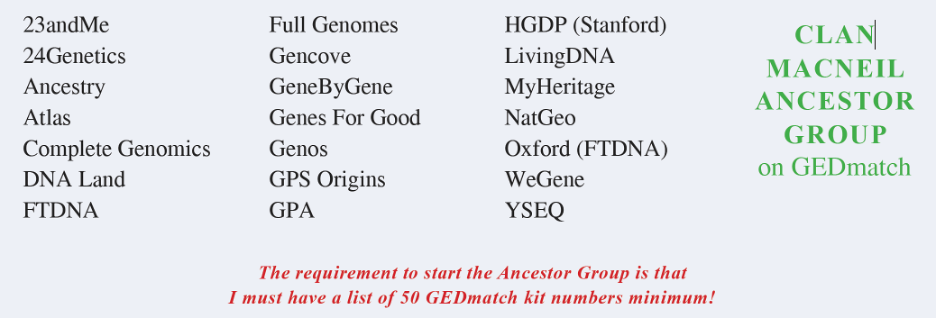
The second project Clan MacNeil hass is on GEDmatch. It aims to compare autosomal DNA results from testing companies around the world for MacNeils. This project is lead by CMAA Genealogist, Alissa Nolan and will provide a global perspective on MacNeil ancestry. It too can help individuals learn more about their genetic connections to others with MacNeil heritage.

Upload DNA results to GEDmatch from these autosomal DNA companies:

To join this project, download your DNA data from your provider (see their site for instructions) and upload the file to GEDmatch. Your upload will generate a kit number. Once you get your kit, email the numberr to Alissa at genealogy@clanmacneilusa.us. If you know them, include your clan ancestor name, and birth and/or death and locations.

Summary

Both projects provide valuable opportunities for MacNeils to learn more about their family history and ancestry. By participating in one or both of these DNA research projects, you can gain a deeper understanding of your heritage. You could possibly connect you with long lost relatives. So, don't wait any longer, unlock the secrets of your DNA today!

Help Weave Together the Fabric that makes up Clan MacNeil Worldwide Read More »