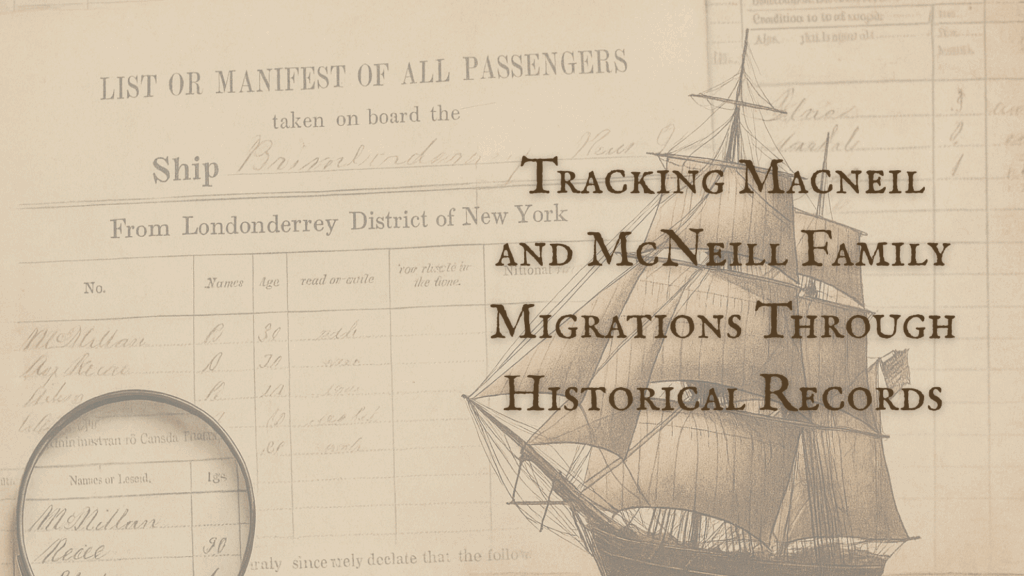
Tracking Macneil and McNeill Family Migrations Through Historical Records

Tracking Macneil and McNeill Family Migrations Through Historical Records

The Macneil (and McNeill) name has traveled far beyond the shores of Barra, Colonsay, and Gigha. Today, descendants can be found across North America, Australia, and beyond. But how did they get there—and how can we track those movements? Thanks to centuries of preserved records, we can piece together the migratory paths of our ancestors and understand the forces that shaped their journeys.

The Power of Paper Trails

From parish registers to ship manifests, historical documents give us glimpses into where our ancestors lived, when they moved, and sometimes even why. Baptismal records, censuses, and wills can confirm family connections across time. Immigration records—especially those from the 18th and 19th centuries—often show McNeils leaving Scotland or Ireland in search of land, opportunity, or religious freedom.

Scotland to Ireland, Then Onward

Many McNeils first left the western isles during the 1600s and 1700s as part of military, economic, or political upheaval. Some settled in Ulster during the Plantation period, and later generations migrated again—to Canada, the U.S., or Australia. These overlapping waves of movement are visible in layered records, where names, occupations, and hometowns reappear across oceans.

What to Look For in Your Own Research

If you’re just getting started tracing your Macneil lineage, focus on:

  • Census and land records in Scotland, Ireland, and early colonies
  • Passenger lists from major ports like Greenock, Liverpool, or Belfast
  • Church records from Presbyterian and Catholic congregations
  • Military service records, especially for Highland regiments

Start with what you know, work backwards, and be ready for spelling variations—Macneil, McNeil, McNeill, and even O'Neill in some cases.

The Journey Continues

Family migration is a story of resilience and reinvention. As Clan Macneil descendants trace their roots, they also map a shared legacy of movement, adaptation, and connection. Whether your family stayed close to the Hebrides or settled on the far side of the world, the records can help you uncover the chapters of that story.

🧭 Want to Dig Deeper? Tools for Tracing McNeill Migration

If you're ready to start your own journey into Macneil or McNeill family history, here are some trusted sites—both well-known and under-the-radar—to help:

Pro Tip: Some databases require paid access or free registration, but many are viewable at public libraries or Family History Centers.

Tracking Macneil and McNeill Family Migrations Through Historical Records Read More »
How to Use Y-DNA Testing to Trace Your Ancestry

Have you ever wondered where your McNeill or Macneil line really came from—or how you're related to others with your surname around the world? Y-DNA testing gives you a way to find out, and no, you don’t need to be a scientist to understand it.

🧬 What Is Y-DNA (and Why Should You Care)?

Y-DNA is a special kind of DNA that only males have. It's passed directly from father to son, almost unchanged, for thousands of years. That means it can tell you a lot about your father’s father’s father’s father, all the way back—potentially even to medieval Scotland or beyond.

If you carry the Macneil/McNeill name or are descended from a male Macneil line, this is the one test that gives you the clearest picture of your ancient and more recent paternal ancestry.


🔍 What Can Y-DNA Tell You About Your Macneil Line?

  • Find out which Macneil/McNeill family line you come from – There are multiple groups: Barra, Gigha, Colonsay, Ulster, etc. Y-DNA helps you figure out which one you belong to.
  • See how you're related to others with the same surname – Are you a close cousin or just share the name?
  • Connect with distant cousins worldwide – From Scotland to Canada to Australia.
  • Discover where your paternal ancestors lived hundreds or even thousands of years ago – Based on your haplogroup (your genetic “branch” on the tree of mankind).

🧪 Which Test Do You Need?

There are two main Y-DNA tests available from FamilyTreeDNA:

Y-37 (Entry Level)
  • Tests 37 markers.
  • Great for getting started, especially if budget is tight.
  • Can be upgraded later.
🔥 Big Y-700 (Best Value)
  • Tests 700+ STRs and over 500,000 SNPs.
  • Places you precisely on the Y-DNA tree.
  • Shows detailed matches, rare mutations, and deeper ancestry.
  • Recommended for anyone who wants serious answers.

If you can afford Big Y-700, start there. Otherwise, begin with Y-37, see who you match, then upgrade.


🌲 What’s a Haplogroup, and Why Does It Matter?

Think of a haplogroup like your family's “chapter” in the big book of humanity. Every male line belongs to a different branch of the Y-DNA family tree. For example:

  • Macneils of Barra tend to show one haplogroup (such as R1b).
  • McNeills of Ulster or Lowland Scotland may show another.
  • Ancient differences can point to Norse, Celtic, or even Iberian roots.

Once you test, you'll see exactly where your branch fits—and how it compares to others in the MacNeil Y-DNA Project.


🧭 How to Use the Results (Even If You’re Not a DNA Geek)

  • Compare yourself to known testers from your surname group.
  • Check the maps – Where are your closest matches located?
  • Read the tree – Your place in the Y-DNA haplotree shows how far back you share a common ancestor with others.
  • Watch for new discoveries – As more men test, new branches form and your results get updated automatically.

👨‍👩‍👧 Can Women Use Y-DNA?

Not directly—but you can ask a male relative to test:

  • Your brother, uncle, cousin, or father—as long as they carry the Macneil Y line.
  • Make sure they descend from the right male line you’re researching.

⚠️ Important Tip

Not all Macneils are genetically related. Some took the name through adoption, clan loyalty, or local tradition. Y-DNA testing helps cut through that confusion and prove whether the connection is real or just on paper.


🎯 Final Thought: Why This Matters

Y-DNA isn't just about ancient history—it’s about knowing where your people come from. It’s about reconnecting with your roots, discovering cousins across the globe, and strengthening our collective Macneil story.

So if you're a Macneil, McNeill, or one of our related families—test your Y-DNA. You're not just doing it for yourself. You're doing it for the clan.

How to Use Y-DNA Testing to Trace Your Ancestry Read More »